
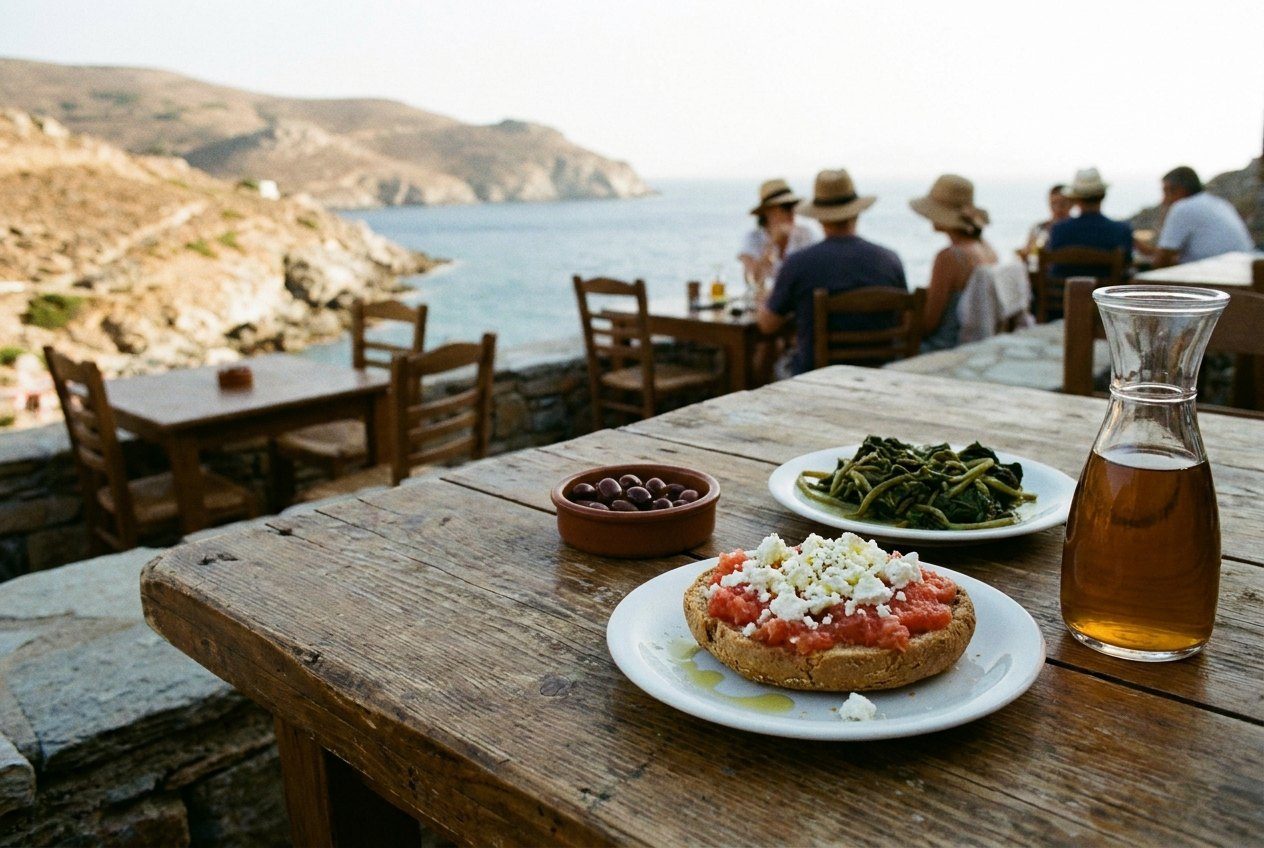
Cretan cooking is the food of a mountainous island that was poor for a long time and rich in a few things: olive oil, wild plants, sheep and goats, herbs, honey and grapes. Out of those it built a cuisine that is plain in method and generous in flavour. Dishes are rarely complicated. What matters is the quality of the oil, the freshness of the greens and the patience of the cook.
Around Elounda and Agios Nikolaos you will find the same dishes on menus as elsewhere on the island, alongside fish from the bay and plenty of food aimed at visitors. The guide below covers the things worth ordering, how a meal tends to run and the small habits that make it feel Cretan.
Oil, bread and the start of the meal
Olive oil sits at the centre of everything. Crete produces a great deal of it, much of it from the small-fruited Koroneiki olive, and it is used without stinting: poured over salads, beans and greens, used for frying, cooking and baking, and drizzled on bread. Good oil here is green-gold and peppery, and a family's own oil is a point of pride. The guide to olive trees and herbs tells the story of the groves and the harvest.
Bread often comes in the form of paximadi, the hard twice-baked rusk made with barley or mixed flours. It was the bread that kept for weeks in a shepherd's bag, and it needs softening with water, oil or the juice of tomatoes before you eat it. A basket of bread and rusks usually arrives at the table as soon as you sit down, sometimes with olives, and may appear on the bill as a small cover charge.
Dakos
The best-known way to eat a rusk is dakos. A large barley rusk is splashed with water, topped with grated ripe tomato and a heap of crumbled soft white cheese, usually mizithra or feta, then finished with oregano, a few olives and a good pour of oil. As it sits, the rusk drinks in the juice and turns from rock-hard to pleasantly chewy. It is a meal on its own on a hot day and one of the dishes that tells you most about the island.
Greens, beans and the hillside
Cretans have always gathered wild plants. Horta, a general word for greens, can mean dozens of species picked from fields and hillsides: dandelion relatives, wild chicory, amaranth, mustard greens and many with only local names. They are usually boiled and dressed with oil and lemon, and they come warm or at room temperature as a side dish. Ask what is in season; the mix changes through the year.
One green has become a delicacy: stamnagathi, a spiny chicory that grows on rocky ground and is now also cultivated. Its young shoots are bitter and crunchy, eaten raw in salads or boiled, and cooked with lamb or goat in a lemon sauce. In spring look also for dishes of artichokes, broad beans and fennel, and for pies filled with greens and herbs.
Beans and pulses fill out the everyday table. Gigantes, big white beans baked in tomato sauce, fava, a smooth purée of yellow split peas with onion and oil, and chickpeas cooked slowly in the oven are all common, cheap and filling.
Snails
Snails are a Cretan speciality and less strange than they sound. The classic dish is chochlioi boubouristi: the snails are laid face down in a hot pan with salt, then fried in oil with rosemary and finished with a splash of vinegar. You pick them out of the shell with a toothpick. They also turn up in stews with potatoes, courgettes or greens, especially in spring and during religious fasts.
Lamb, goat and the slow pot
Meat in the traditional diet was for Sundays and feasts, and much of it came from the sheep and goats that graze the hills. That shows in the way it is cooked: slowly, often in the oven or over embers, with herbs from the same hillsides the animals grazed.
- Lamb or goat baked in the oven with potatoes, lemon and oregano until the meat falls from the bone.
- Kleftiko-style lamb sealed in paper or foil and cooked slowly in its own juices.
- Antikristo, a mountain method in which pieces of lamb are set on tall skewers around an open fire and cooked slowly by the heat.
- Goat with stamnagathi or with artichokes in an egg and lemon sauce.
- Gamopilafo, the rich rice cooked in meat broth and finished with butter, served at weddings and feasts.
Rabbit and rooster stewed in wine also appear in villages. Pork is cooked as well, notably in cured forms such as apaki, strips of pork marinated in vinegar and smoked with herbs. Near the coast, grilled fish and fried small fish are common, priced by weight on many menus; ask what is fresh and how much your choice will cost before it is cooked.
Cheese and honey
Crete's cheeses are made mainly from sheep's and goat's milk, often mixed. Three turn up almost everywhere:
| Cheese | What it is like | How it is eaten |
|---|---|---|
| Graviera | Hard, nutty and slightly sweet, aged in wheels | Sliced with bread, grated over pasta, fried as saganaki |
| Mizithra | Soft, fresh whey cheese, mild and crumbly | On dakos, in pies, with honey as a sweet |
| Anthotyros | Fresh or dried whey cheese, firmer than mizithra | On salads, grated, or with fruit |
Small cheese pies called kalitsounia are a classic of the island, filled with fresh cheese and sometimes with mint or greens, baked or fried. You will also meet a thin pie filled with cheese, fried and served with honey poured over it, a speciality of the west of the island now made in many places. The salty, sweet contrast is very Cretan.
Honey is the other great product of the hills. The best known is thyme honey, dark gold and strongly scented, made by bees that work the wild thyme in early summer. It is eaten with thick yoghurt, poured over cheese, used in pastries and simply spread on bread. Beekeepers sell it from roadside stands and village stores; small producers' honey tends to vary more from jar to jar, which is part of its appeal.
Raki and the end of the meal
Raki, also called tsikoudia, is the island's spirit, distilled from the skins and pips left after wine making. It is clear, strong and drunk in small glasses, usually neat and often cold. Distilling takes place in autumn, when villages fire up their copper stills and friends gather around them with food.
At the end of a meal, many places bring a small carafe of raki and something sweet, often fresh fruit, a spoonful of preserved fruit or a piece of cake, without being asked. It is a custom of hospitality rather than something you have ordered. Sip, do not feel obliged to finish it, and if you are driving, leave it on the table. Some places offer a sweet liqueur or wine instead.
Wine is the other drink of the table. Crete has old grape varieties of its own, and local producers make wines worth trying. House wine, served by the carafe or by the kilo, varies widely; try a small measure first.
How a meal runs
The Cretan way to eat is to order several dishes for the middle of the table and share them, adding more as the evening goes on. A typical order might be a salad, a plate of greens, a dip or two, some cheese, a pie and then one or two cooked dishes. Nobody expects you to have one plate each.
Meals are slow. Lunch can start late and run for hours; dinner seldom begins before nine in summer, and many locals sit down later. Waiters will not usually bring the bill until you ask for it, which is a courtesy rather than neglect, so ask when you are ready. Rounding up or leaving a few coins for good service is normal but not required.
- Look for menus with a short list of daily cooked dishes; they are usually the freshest.
- Ask what greens and vegetables are in season.
- Order little and often rather than everything at once.
- In summer, choose a table with shade at lunch and drink plenty of water as well as wine.
Dishes are rarely complicated.
If you want to taste the island at its source, the inland villages are the place: try lunch in a village such as Kritsa, described in the guide to Kritsa and Panagia Kera, or on the high plain covered in the guide to the Lasithi Plateau, where potatoes, apples and cheese come from the surrounding fields.
Photographs: Dietmar Rabich / CC-BY-SA-4.0; ArtemiyPavlov / CC-BY-SA-3.0; Florian Waßmann / CC-BY-3.0; Mietek Ł / CC-BY-SA-3.0; Vadim Indeikin / CC-BY-SA-3.0


