
Kritsa climbs a hillside a short way inland from Agios Nikolaos, its houses stacked on the slope beneath bare grey rock. It is one of the larger villages in the district and one of the most visited, mainly for two reasons: the church of Panagia Kera, which stands among trees just below the village, and the long main street of shops hung with woven rugs, embroidered cloths and lace.
Visit early and you have both almost to yourself. By late morning in summer the coaches arrive, and by mid-afternoon they have gone again.
Panagia Kera
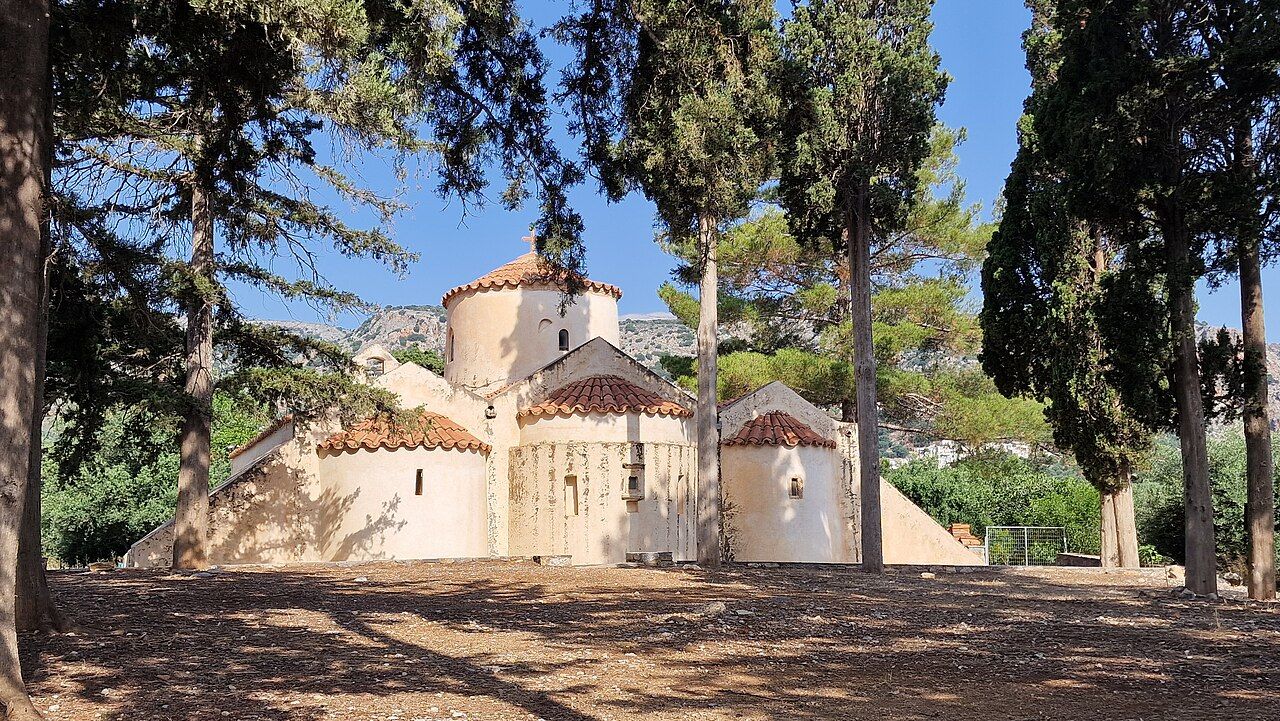
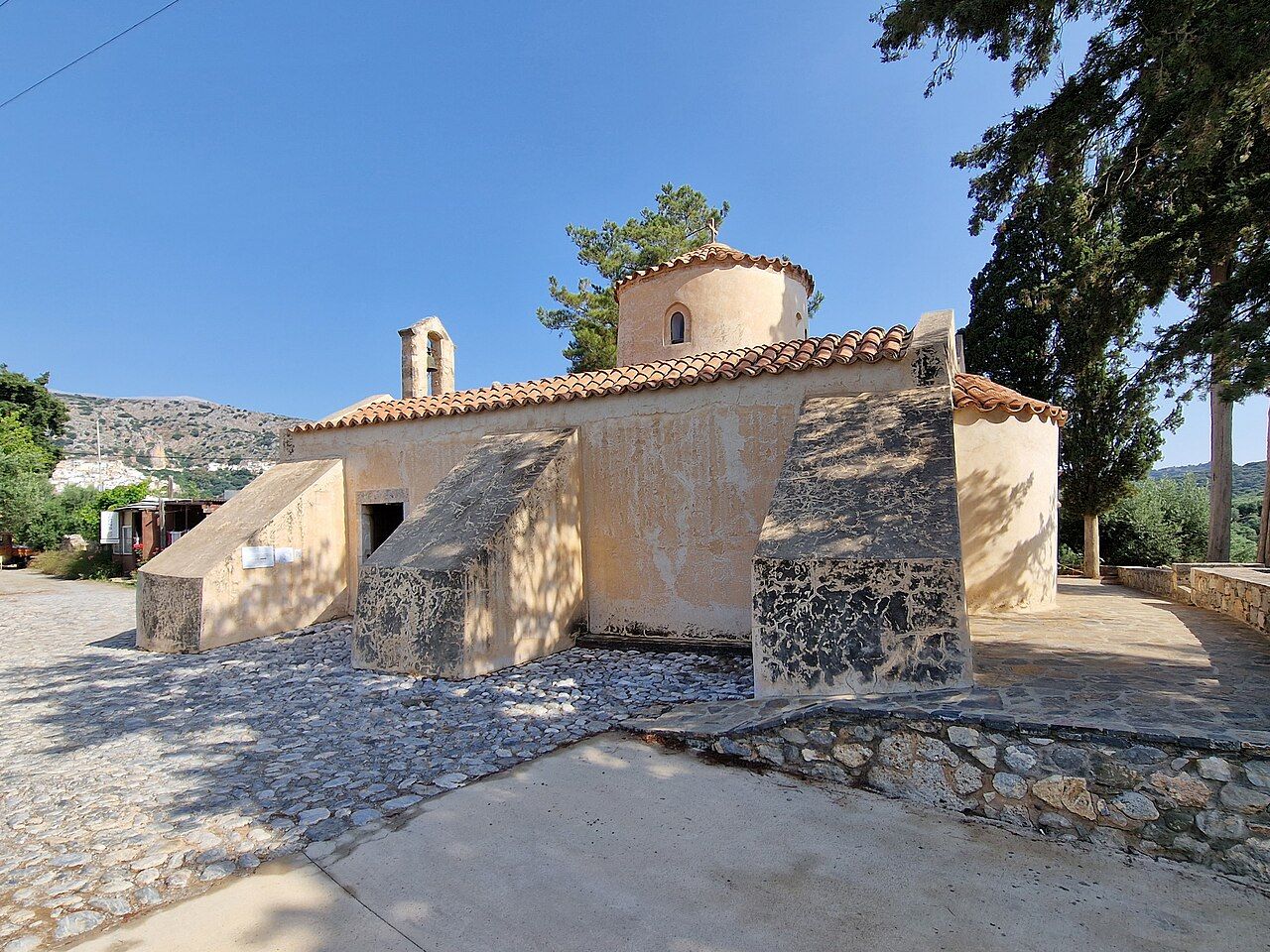
The church sits beside the road from Agios Nikolaos about a kilometre before the village, shaded by tall cypresses and pines. From outside it is modest: whitewashed walls, a small dome on a drum, tiled roofs and heavy stone buttresses that were added later to hold up the walls. It has three aisles, built at different times, each ending in its own apse.

Inside, almost every surface is painted. The frescoes date from roughly the thirteenth and fourteenth centuries, and together they make one of the most complete painted interiors on the island. They are not pristine: some faces are scratched, some colours have faded, and a few sections are lost. That only adds to the sense that they have been looked at, prayed before and lived with for seven hundred years.
What to look for
- The central aisle, the oldest part, with scenes from the life of Christ around the dome and the Last Supper and the Massacre of the Innocents on the walls.
- The south aisle, dedicated to Saint Anne, with an unusual cycle on the life of the Virgin's parents and her childhood.
- The north aisle, dedicated to Saint Anthony, with a Last Judgement and a garden of the blessed filled with saints.
- Small portraits of the donors who paid for the work, dressed in the clothes of their day.
The church is small and the light inside is dim, so give your eyes a minute to adjust. Photography rules have varied over the years, and flash is generally not allowed; ask or look for signs. Hours and an entry charge apply, and both change with the season. Dress as you would for any working church, with shoulders and knees covered.
The village
Kritsa proper begins at the top of the road with a small square and a large church, then spreads uphill in a tangle of lanes and steps. The main street is the commercial one, lined with shops selling textiles, ceramics, honey and herbs. Away from it the village is quieter, with whitewashed houses, pots of basil and geraniums, and old men at café tables watching whoever passes.
Walk up beyond the shops and the lanes get steeper and more residential. There is no fixed route; follow the slope and you will come out above the roofs with a view down to the coast. The village is a good place for an unhurried lunch, and the guide to Cretan food will help with the menu.
Weaving, embroidery and lace
Kritsa has long been known for its textiles. Women here wove on wooden looms at home, making rugs, blankets, bags and the dowry cloths that a bride brought to her marriage. Embroidery and lace work, done with fine needles or crochet hooks, decorated tablecloths, pillowcases and curtains. Many families still hand these skills down, and in some houses a loom stands in a corner.
Today much of what hangs in the shops is made locally, but not all of it, and quality varies a great deal. Real handwork takes many hours, and its price reflects that; very cheap pieces are usually machine-made or imported. If you are buying, take your time, look at the back of the work as well as the front and ask how and where it was made. There is no obligation to buy anything, and a polite look is welcome.
The gorge below the village
East of the village, the Kritsa gorge cuts into the limestone. It is a rugged walk rather than an easy path: the floor is a dry stream bed of boulders and gravel, the walls close in to a few metres in places, and there are spots where you need to use your hands to scramble down a rock step. In winter and early spring there can be water, and after heavy rain it is best avoided.
Most people walk in from the lower end, near the road below the village, and turn back when they have had enough, retracing their steps. Longer routes continue upstream and loop back to Kritsa on farm tracks. Wear proper walking shoes, take plenty of water and a phone, and tell someone where you are going. There is shade in the narrow sections but very little on the approach.
Combining the day
Kritsa sits at the centre of a good half-day or full day from Elounda. The ancient hill city of Lato lies a few kilometres to the north along a signposted side road, and together the two give you two very different ages of the island in one morning. The guide to the Dorian city of Lato has the details.
A sensible order in summer is Lato at opening time, then Panagia Kera, then the village for lunch, leaving the gorge for a cooler season. In spring, when the hillsides are green, you can reverse it and walk in the morning instead.
Up through the olive groves to Kritsa
From Elounda, drive south along the coast to Agios Nikolaos, then follow signs inland to Kritsa. The road climbs steadily through olive groves for about ten kilometres, and the church appears on the left just before you reach the village. There is roadside parking near the church and larger car parks near the top of the village.
Buses connect Agios Nikolaos with Kritsa a few times a day, and you can reach Agios Nikolaos from Elounda by local bus or taxi. Timetables change with the season; the guide to getting around east Crete has more on public transport.
Lent to this page by
Photographs: Bernard Gagnon / CC-BY-SA-4.0; Rigorius / CC-BY-SA-4.0; Kostdro / CC-BY-SA-3.0; Dietmar Rabich / CC-BY-SA-4.0


