
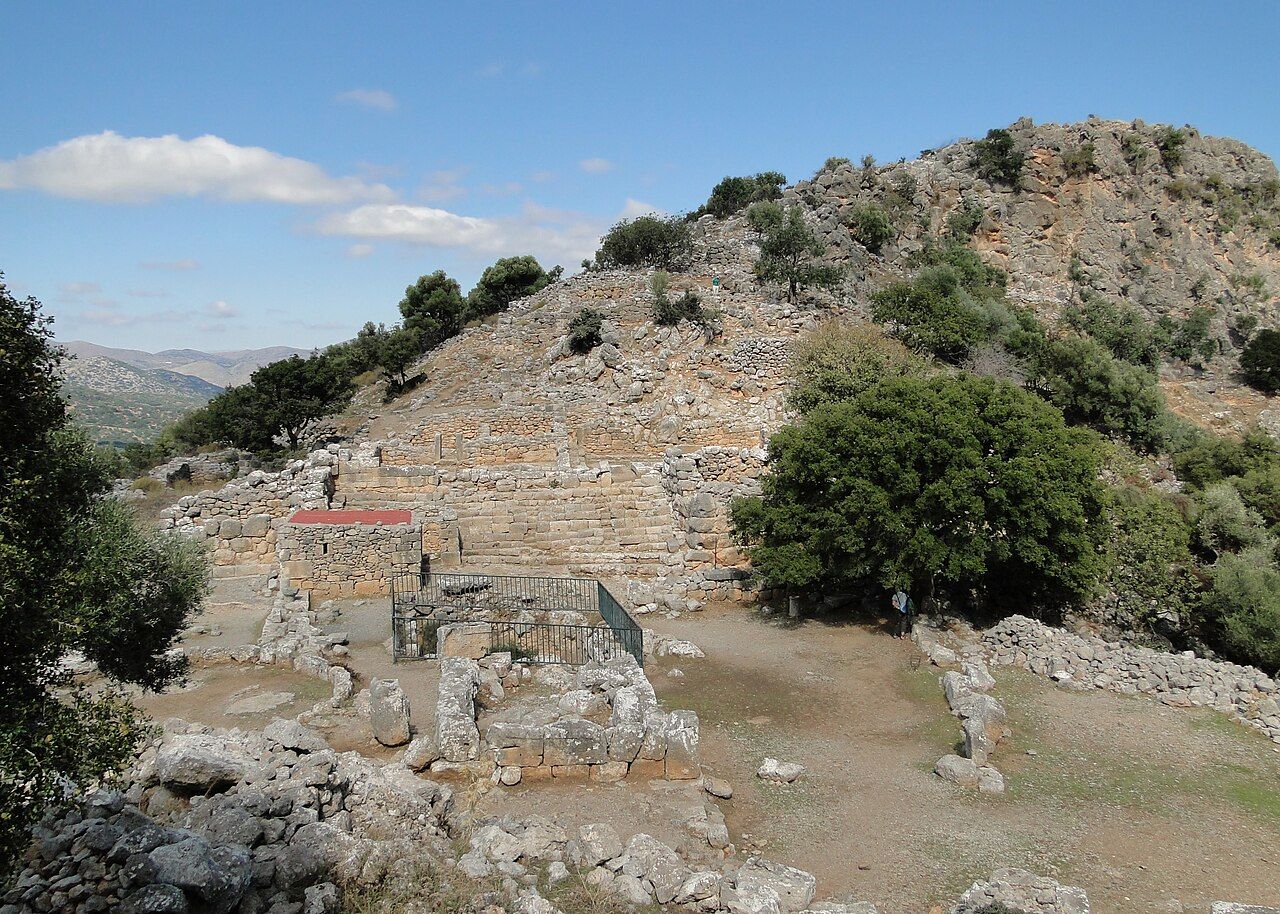
Most of the ancient sites around Elounda are Minoan, low and spread out, or lie under the sea at Olous. Lato is different. It is a city of the first millennium BC, built by Dorian Greeks on a saddle of land between two rocky peaks in the hills north of Kritsa, and its houses, stairs and public buildings are packed into the slope in a way that still makes sense when you walk through it.
It is also usually quiet. Coach tours tend to stop at the church below Kritsa and drive on, so the city on the hill is often left to a handful of visitors, the lizards and the wind.
A city between two peaks
The site sits in a natural hollow with a summit to the north and another to the south, each of which once had its own acropolis. The city filled the ground between them. Its position made sense for defence and for watching the coast: from the upper terraces you look straight down the valley to the bay, and on a clear day you can follow the shore round towards Agios Nikolaos.
The name is usually linked to the goddess Leto, mother of Apollo and Artemis, whose cult appears on the city's coins. Lato had a harbour town on the coast, Lato pros Kamara, at the site of present-day Agios Nikolaos, which you can visit with the help of the guide to the town around Lake Voulismeni. Most of what stands on the hill dates from the Classical and Hellenistic centuries, when Lato was one of the many small city-states that shared, and often fought over, eastern Crete.
Walking in from the gate
The entrance path brings you in near the lower gate. From there a long street climbs the slope, partly as steps, with the walls of houses and workshops on either side. The stones are worn smooth in places and loose in others, so watch your feet and take your time. Small rooms open off the street, some with thresholds still in place, and you can trace where the doorways stood.
Along the street you will notice towers built into the walls, part of the defences that once protected the inner city. The route is short in distance but steep in places, and in the heat of midday the stone reflects the sun back at you.
The agora and the great stair
The street opens into the agora, the civic square, which lies in the saddle itself. It is not large, but it is the heart of the place. In the middle is a fenced cistern, cut to store rainwater for a city that had no river, and nearby are the foundations of a small shrine. Along one side runs a stoa, a covered colonnade, of which the base remains.
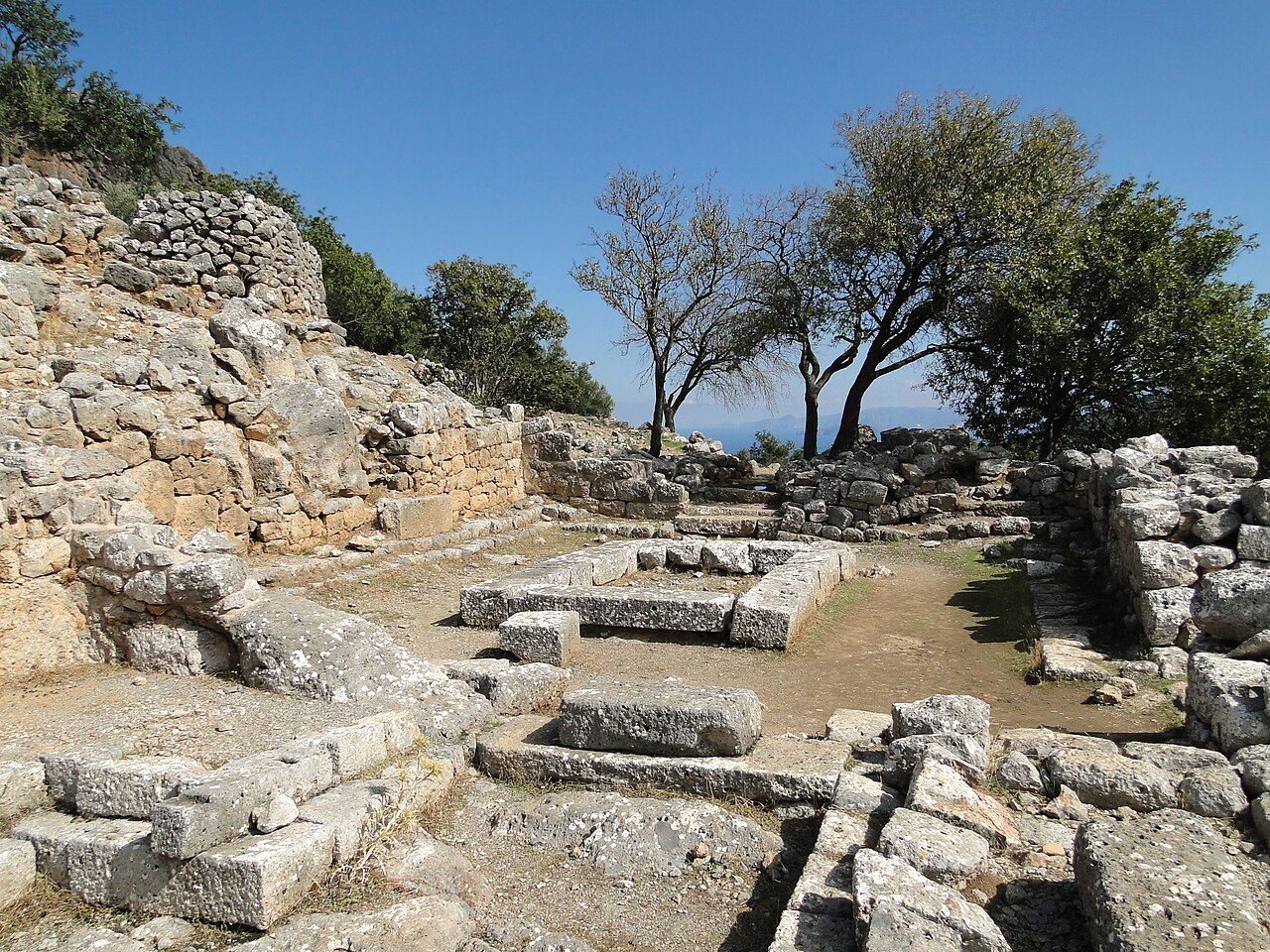

On the north side of the agora a broad flight of steps rises towards the prytaneion, the building where the city's officials met and where a sacred fire was kept burning. The lower steps are wide enough to have been used as seating, and they are often described as a small theatre, a place where citizens could gather and listen. Sit on them for a moment and look south over the square: it is easy to imagine an assembly here.
Climb the stair and you reach the prytaneion itself, with a central hall, a hearth and rooms around it. From its terrace the view runs the length of the valley to the Mirabello Bay. On the opposite side of the agora, a little above it, are the remains of a temple and a larger theatre area, less complete but worth a look.
Quiet hours and the heat
Lato is an open hillside with only a few trees, and most of them stand at the edges rather than over the paths. In summer the best times are the first hour after opening and the last part of the afternoon, when the light softens and the shadows show the shape of walls and steps. In spring the hillside is green, with wild flowers among the stones and almond trees in blossom in some years, and it is a pleasure at any time of day.
- Bring water; there may be no café or shop at the site.
- Wear shoes with grip; sandals slide on the polished stones.
- A hat and sun cream matter even on a breezy day.
- Keep to the paths and do not climb on walls; the ruins are fragile.
Opening days, hours and the entry charge change, and small sites on the island sometimes close for a day with little notice.
The signposted turn before Kritsa
From Elounda, drive south to Agios Nikolaos and take the road up to Kritsa. Just before the village, a signposted road branches north towards the site, climbing through olive groves for a few kilometres to a small parking area near the entrance. The whole trip usually takes about half an hour to forty minutes, depending on traffic in Agios Nikolaos.
Buses run between Agios Nikolaos and Kritsa, but not to Lato itself. From Kritsa it is a walk of roughly an hour each way on a quiet road with no shade to speak of, so it is better done early or late, or not at all in July and August.
Combining Lato with Kritsa
Lato pairs naturally with a visit to Kritsa and the frescoed church of Panagia Kera just below the village. A good order is the hill city first thing, while it is cool, then the church, then a late lunch in the village. If you still have energy, the gorge below Kritsa offers a walk among boulders and oleanders; the guide to Kritsa and its painted church covers all three.
For a sense of how Lato fits into the wider story of the island, compare it with the Minoan palaces. Knossos was already a ruin of a thousand years when the citizens of Lato climbed their great stair, and the change in scale, from palace to small city-state, tells you a good deal about how Crete changed. The guide to Knossos takes up that earlier story.
Lent to this page by
Photographs: Rigorius / CC-BY-SA-4.0; Mustang Joe / CC0-1.0; Moonik / CC-BY-SA-3.0; Rigorius / CC-BY-SA-4.0; Kostdro / CC-BY-SA-3.0


