
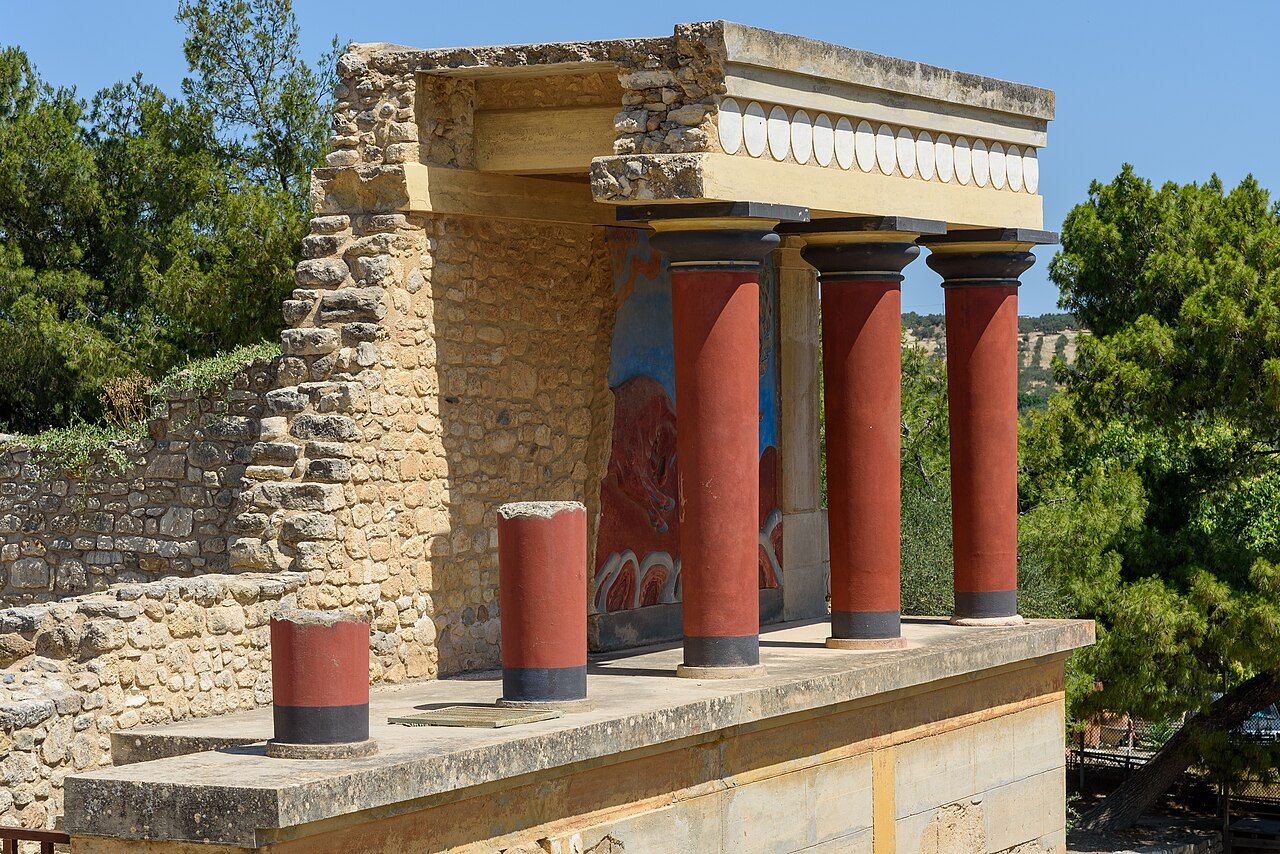
Knossos lies in a gentle valley a few kilometres south of Heraklion, surrounded by low hills, vines and pine trees. It was the largest of the Minoan palaces, the centre of a Bronze Age civilisation that flourished on Crete thousands of years ago. It is also the busiest ancient site on the island. With good timing and a clear plan, though, you can see it calmly.
The palace and its people
The Minoans built their first palace at Knossos around four thousand years ago, on a hill that had been lived on for thousands of years before. The palace was damaged by earthquakes and rebuilt more than once, growing into a vast complex of rooms, courts, stairways and storerooms arranged around a large central court.
It was not only a royal house in the modern sense. It was also a centre for storage, craft, administration and religion. Huge clay jars once held oil, grain and wine, and records were kept on clay tablets. The people who lived and worked here left behind wall paintings, carved stone vessels, fine pottery and jewellery, much of it now in the museum in Heraklion.
The palace was eventually destroyed and abandoned, and over time the site was buried. It was identified in the late nineteenth century and excavated on a large scale from 1900 onwards.
Evans and the concrete question
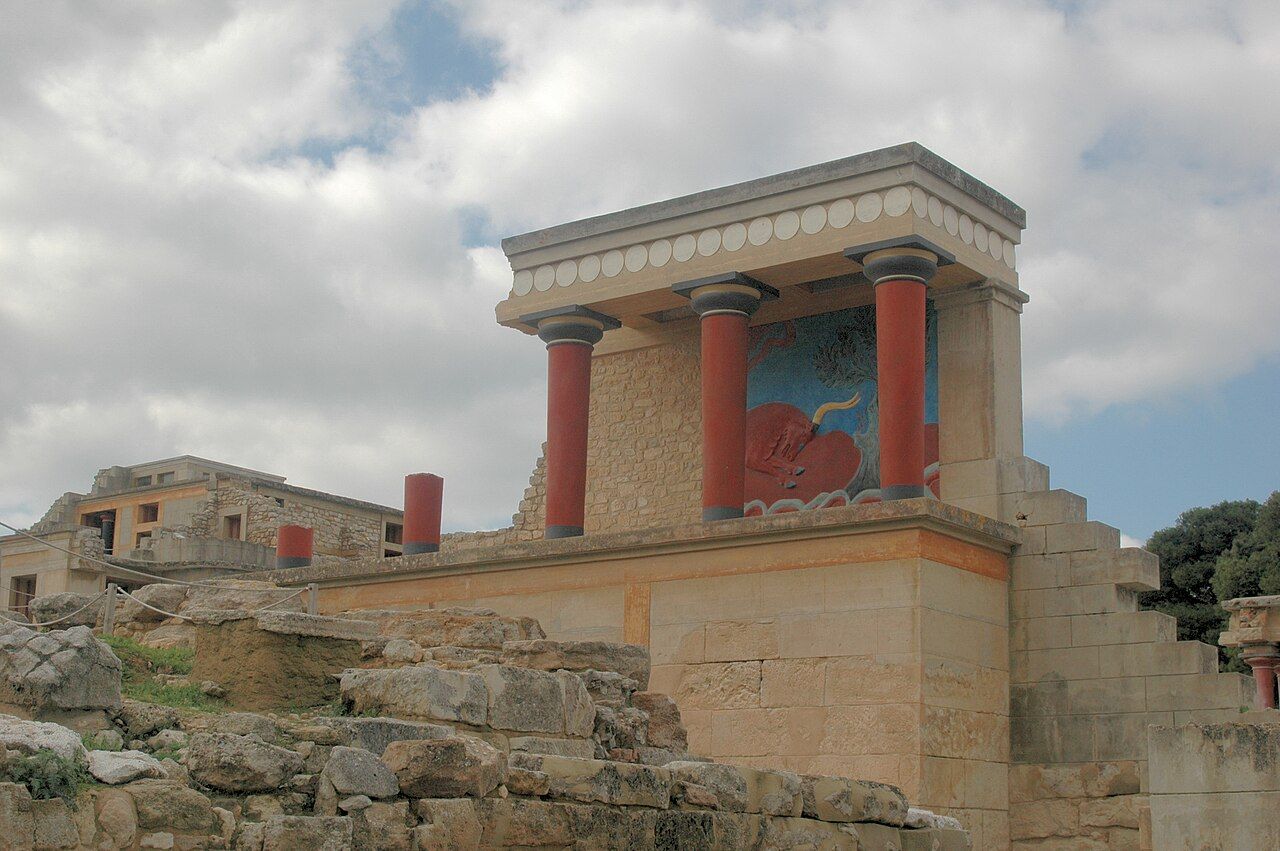
The excavation was led by the British archaeologist Arthur Evans, who spent decades at Knossos. He did more than dig. He rebuilt parts of the palace, using reinforced concrete to restore columns, walls, stairways and upper floors, and he had copies of wall paintings put up in place.
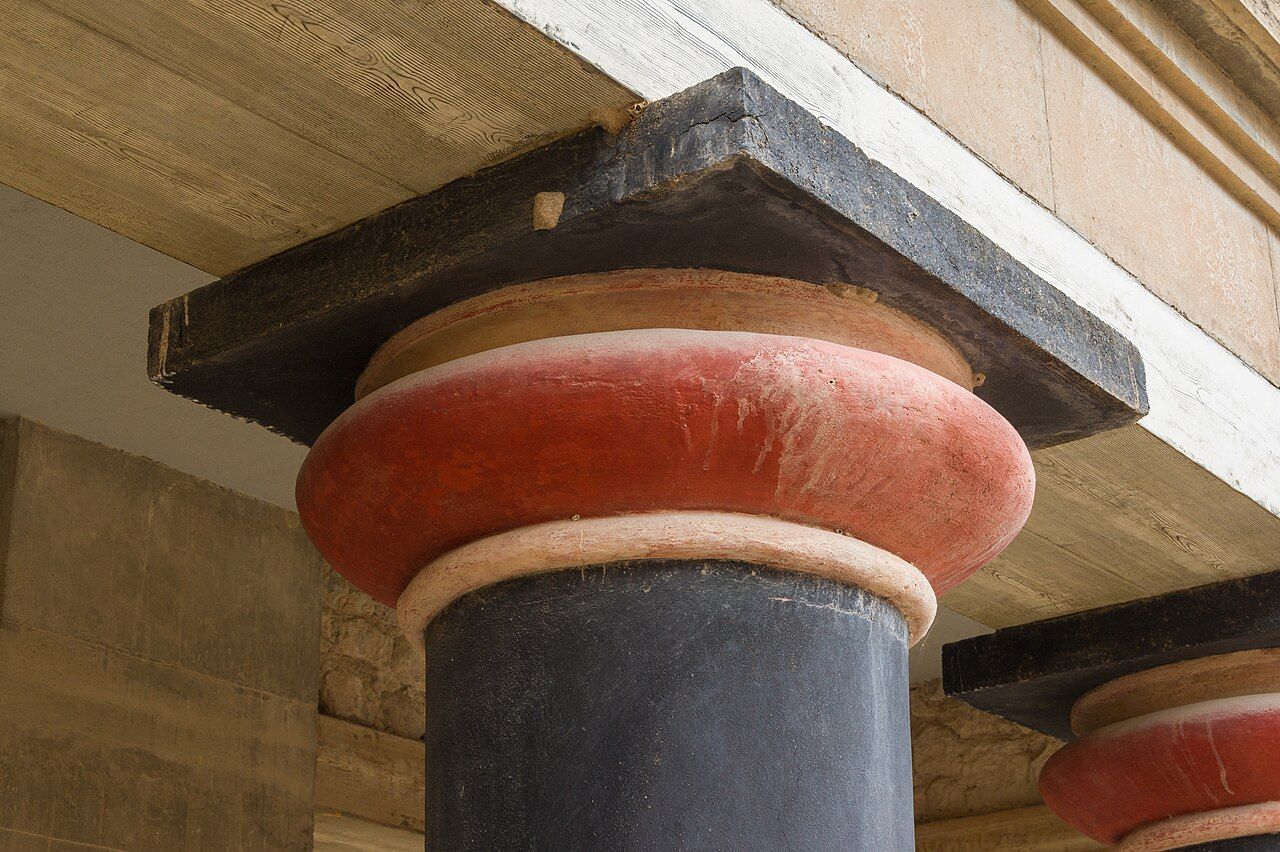

These reconstructions are the most debated thing about Knossos. Supporters say they help visitors understand a building that would otherwise be a field of low walls. Critics argue that Evans guessed too much, that some details are wrong, and that the concrete has harmed the original remains. Both sides have a point. When you visit, it helps to remember that much of what you see standing is a twentieth-century interpretation built on ancient foundations.
When you visit, it helps to remember that much of what you see standing is a twentieth-century interpretation built on ancient foundations.
The red columns, which narrow towards the bottom, are the best-known feature of the reconstructions. They are based on evidence from the excavation, but their colour and exact form are part of Evans's reading of the site.
A route through the site
The site is large and can be confusing, and the paths change as conservation work moves around. A sensible route, adjusted to whatever is open on the day, looks like this:
- Enter and walk along the west side of the palace, past the large round pits and the west court.
- Follow the path to the central court, the heart of the palace, a large open space surrounded by buildings.
- Look into the throne room on the west side of the court, with its stone seat and painted walls.
- Cross to the east side to see the grand staircase and the residential quarter, where reconstructions show rooms on several levels.
- Walk north to the north entrance, with its reconstructed portico and the copy of a charging bull relief.
- Finish at the theatral area and the old paved road that led out from the palace.
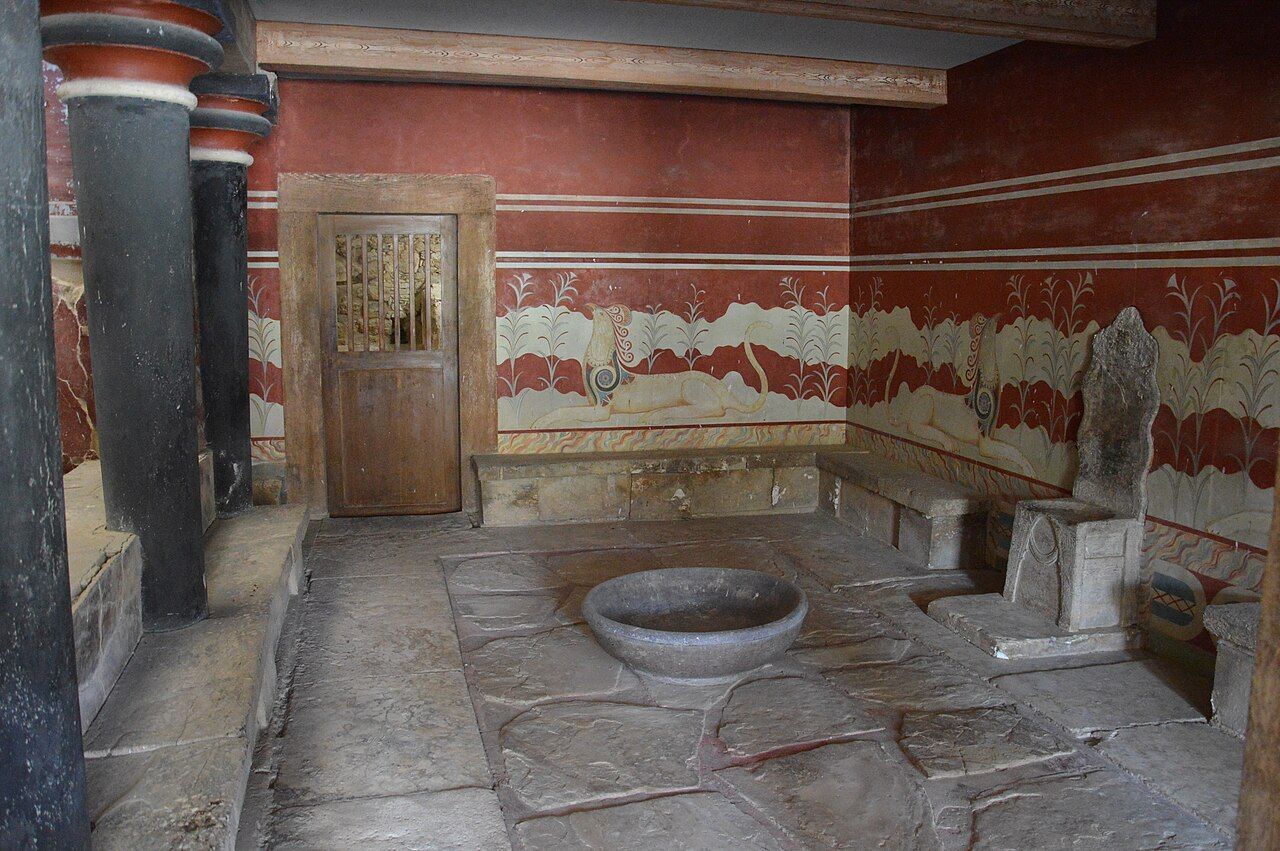

Allow at least two hours. The throne room is small and often has a queue to look in. Some areas are closed off for protection, and the routes are marked with ropes and boards.
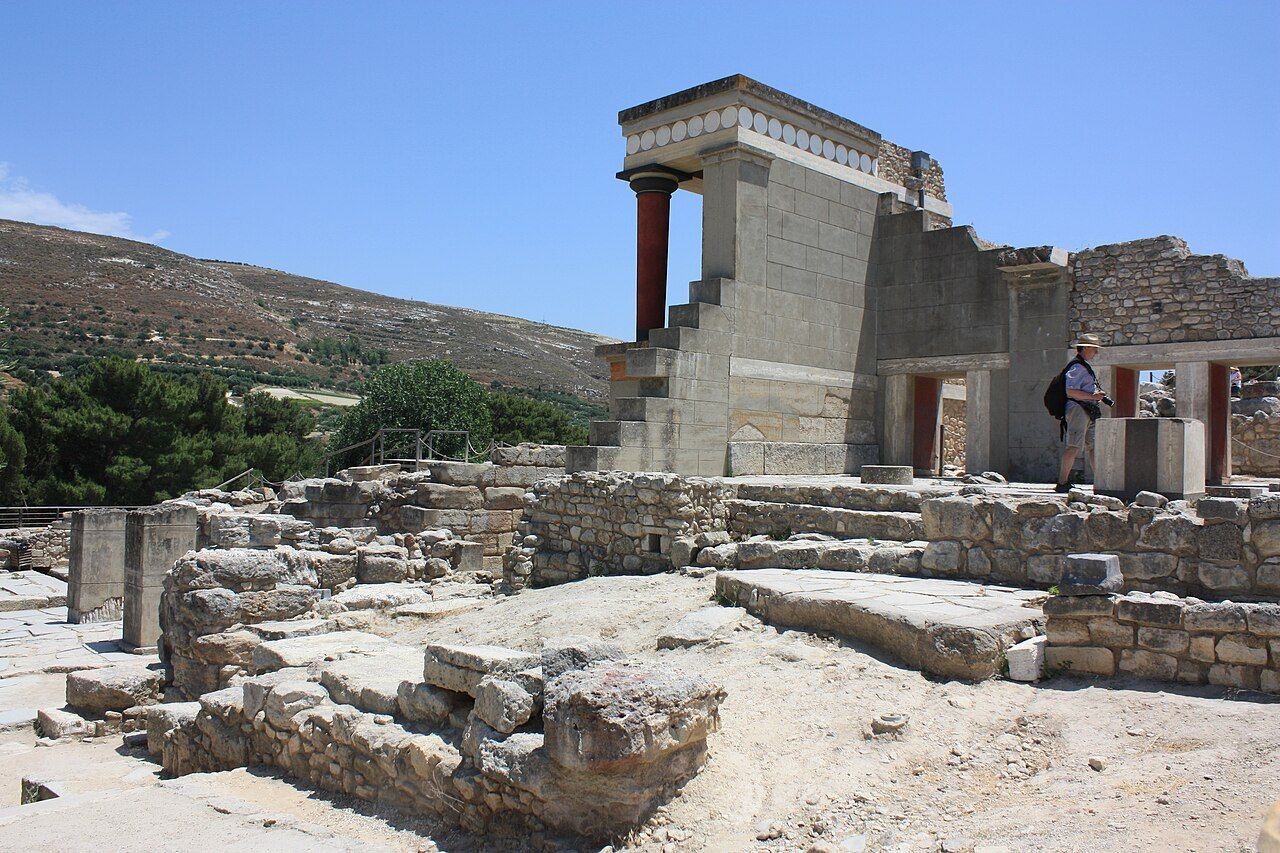

Guides and information
Information panels explain the main areas, and licensed guides are often available at the entrance. A good guidebook or map makes a big difference, as the site is hard to read without help.
Myth and the maze
Greek myth placed King Minos at Knossos, along with the labyrinth built by Daedalus and the Minotaur, half man and half bull, shut away inside it. Legend says Theseus found his way out of the maze with a thread given to him by Ariadne. Nobody knows whether these stories remember anything real, but it is easy to see why the palace made people think of a maze. Its corridors, light wells, stairs and small rooms turn back on themselves, and even with modern paths it is hard to keep your bearings. Bulls appear again and again in Minoan art, in frescoes, carved stone and the famous scenes of young people leaping over a charging animal. Evans borrowed the name of the legendary king to call the whole civilisation Minoan, a label that has stuck ever since.
Timing for heat and coaches
Knossos gets very busy. Coach groups arrive from mid-morning, especially in summer, and the paths can become crowded. The heat is also a serious issue. The site is open and exposed, with only a few pine trees for shade, and the stone reflects the sun.
- Arrive when the site opens. The first hour is the coolest and calmest.
- The late afternoon, before closing, is the second-best window.
- Carry at least a litre of water each, and wear a hat and sun cream.
- Shoes with good grip help on the worn stone paths and steps.
- Avoid the middle of the day in July and August.
Tickets are often sold for timed entry, especially in high season, and buying online in advance may be required or advisable. Opening hours change between summer and winter, and prices change too.

Knossos and Heraklion in one day
From Elounda, the drive to Knossos takes around an hour and a quarter, mostly on the national road west past Agios Nikolaos towards Heraklion. The road is busy and has some fast stretches, so drive carefully. Parking near the site is usually available, though it fills up later in the day. Our guide to getting around east Crete covers the national road and buses.
Buses run from Agios Nikolaos to Heraklion, and from Heraklion city local buses go to Knossos. This is a long day by public transport, but it is possible.
The best way to understand Knossos is to pair it with the Archaeological Museum in Heraklion, which holds the original frescoes, pottery and objects found at the site. Many people visit the site early in the morning and spend the hottest hours in the museum, which is indoors and cooler. Our guide to Heraklion's museum and town describes what to see there.
Knossos keeps its power to impress, even with its crowds and its concrete. Arriving early, following a clear route and seeing the museum the same day makes it far more than a quick stop on a coach tour.
Lent to this page by
Photographs: Moonik / CC-BY-SA-3.0; Bernard Gagnon / CC-BY-SA-4.0; Rigorius / CC-BY-SA-4.0; Rigorius / CC-BY-SA-4.0; Kostdro / CC-BY-SA-3.0


