Most people who stay around the Mirabello Bay see Heraklion twice: once from the airport road on the way in and once on the way out. It deserves a day of its own. The city is the island's capital and its largest town, with traffic, apartment blocks and a working port, and none of the polish of the resort coast. Inside that bustle sits the museum that explains everything you see at Knossos, Malia and the other palace sites, plus a sea fortress, a lion fountain and several kilometres of Venetian walls.
A sensible plan is the museum in the morning, when you are fresh and the rooms are cooler, then lunch and a slow walk from the old harbour up through the centre to the bastion where Nikos Kazantzakis is buried. If you want to pair the city with the palace, read the guide to the Minoan palace of Knossos first; doing both in one summer day is possible but tiring.
The Archaeological Museum
The Heraklion Archaeological Museum holds the great bulk of what has been dug up from Minoan Crete. The ground floor runs roughly in date order, from Neolithic tools and early sealstones through the palace periods to the later Greek and Roman finds. Upstairs are the wall paintings from Knossos and other sites, restored from fragments and hung so you can stand close.
Some pieces stop almost every visitor:
- The Phaistos Disc, a clay disc stamped in a spiral with signs nobody has convincingly read.
- The faience figurines usually called the snake goddesses, holding snakes in raised or outstretched hands.
- The bull's head drinking vessel in black stone, with inlaid eyes and gilded horns restored.
- The small gold pendant from Malia with two bees or wasps around a drop of honey.
- The painted stone sarcophagus from Agia Triada, with scenes of offerings and music.
- The bull-leaping fresco upstairs, with athletes vaulting over a charging animal.
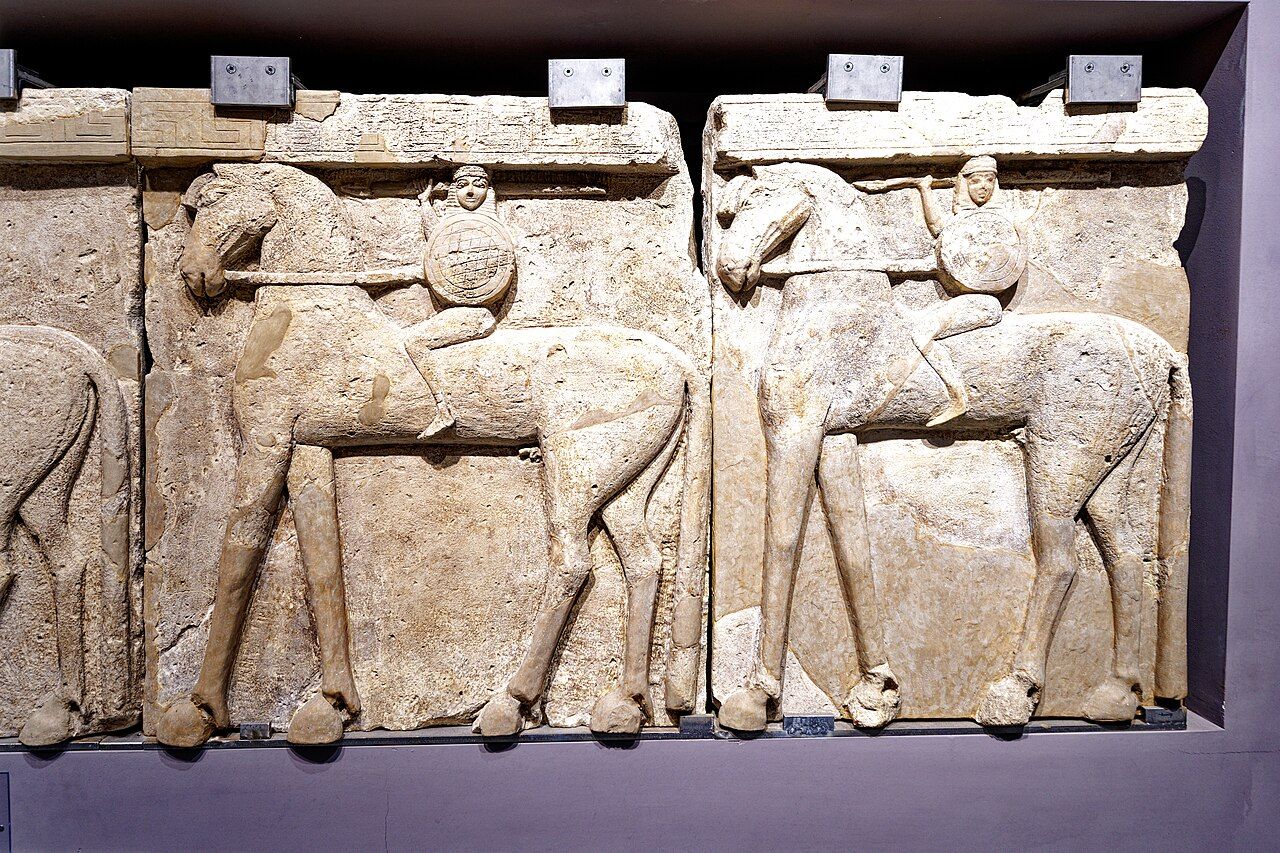
Later rooms are easy to rush but worth slowing for. The Archaic Greek sculpture includes stone reliefs of horsemen with round shields, a reminder that the island's story did not stop when the palaces fell.

Opening hours and ticket prices change with the season and sometimes with little notice, and there are combined tickets with Knossos at times. Allow at least two hours inside; three is better if you like to read labels. Bags may need to go in a locker.
Koules, the fortress on the harbour
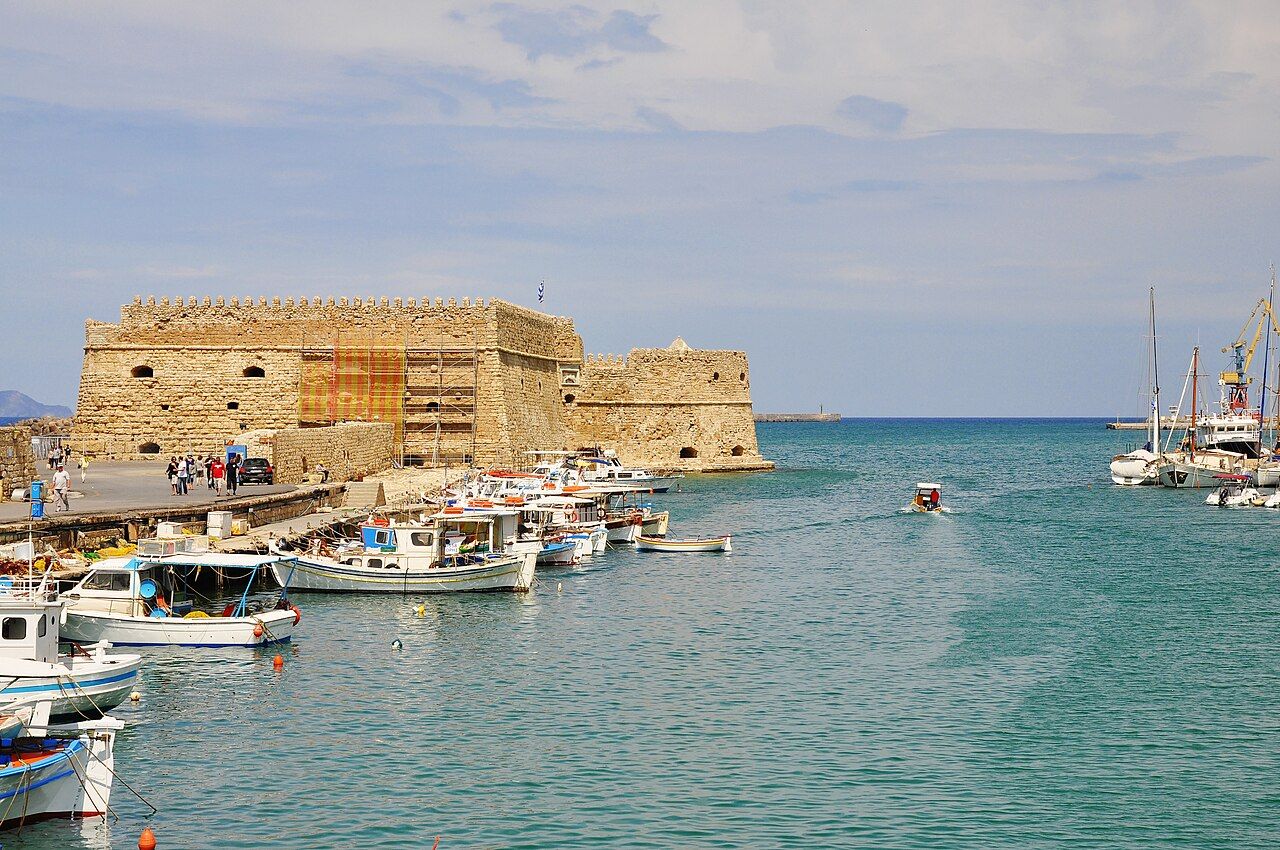
Walk down to the old harbour and the squat, honey-coloured fort at the end of the breakwater is impossible to miss. The Venetians called it Rocca a Mare, the rock on the sea; Cretans call it Koules, from the Turkish word for a tower. What you see was built in the sixteenth century to guard the entrance to the port of Candia, as the Venetians named the town, and it held out through the long Ottoman siege of the seventeenth century before the city finally fell.
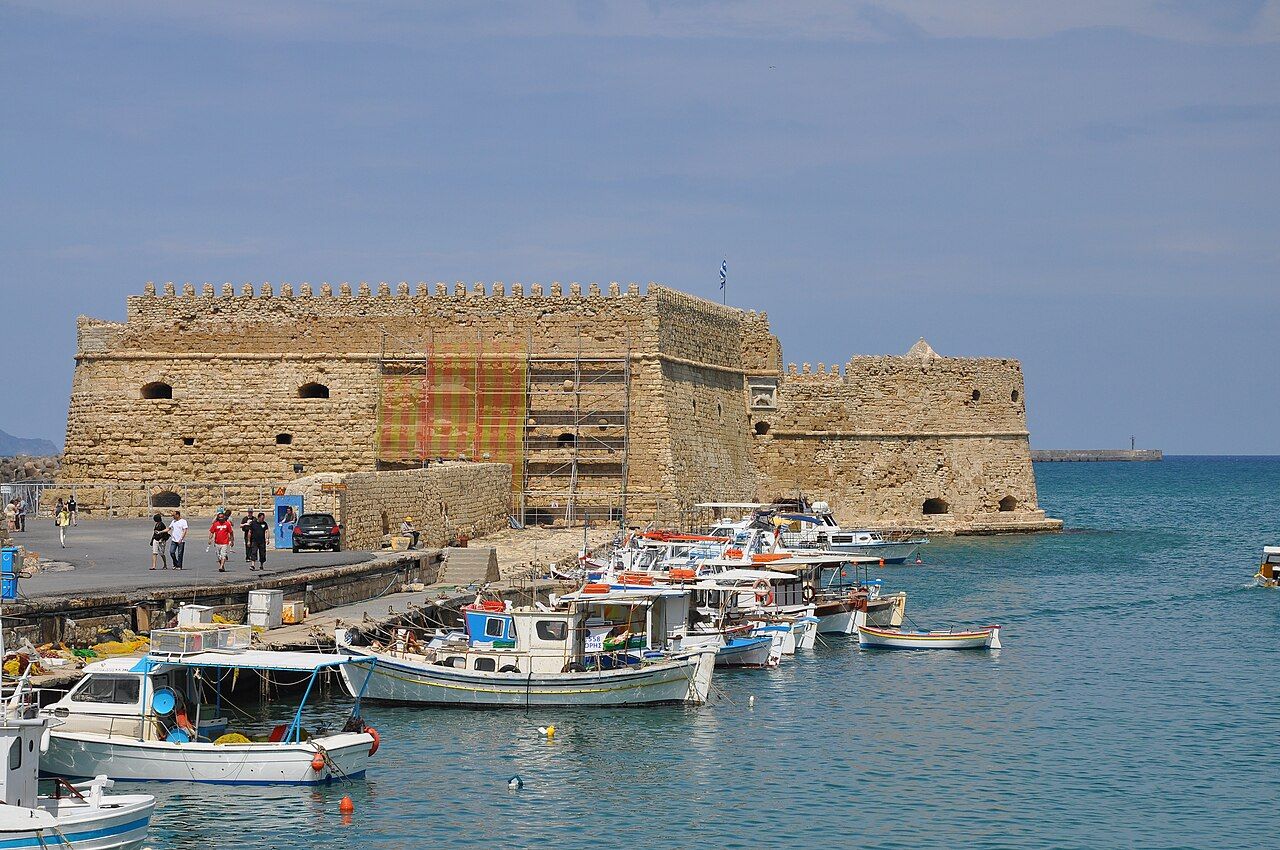

Inside are vaulted halls and gun ports, and a ramp up to the roof with wide views over the harbour, the modern ferry quays and the hills behind the city. Look for the carved winged lions of Saint Mark on the outer walls, the badge of Venice. The breakwater beyond the fort is a popular evening stroll and catches whatever breeze there is.
Entry times and charges for the fort vary, and it has been closed for works in the past. The walk along the breakwater is open regardless and free.
From the harbour to the Lion fountain
From the harbour, 25th August Street climbs gently into the centre. Along it you pass the arched Venetian arsenals near the water, the church of Agios Titos on its square and the rebuilt Venetian Loggia, which now serves as the city hall. The street is lined with buildings from the early twentieth century and is mostly pedestrian, so it is a pleasant climb even in warm weather.
At the top is the square everyone calls Lions Square, officially Eleftheriou Venizelou. In its middle stands the Morosini fountain, built in the seventeenth century under the Venetian governor Francesco Morosini to bring water into the town by aqueduct. Four stone lions hold up the basin, older than the carved panels around it. It is a natural place to sit, and the streets around it are where the city eats and drinks.
A short walk south-west takes you to the large cathedral of Agios Minas and the much smaller old church of the same name beside it. The central market street, with stalls selling herbs, cheese, honey and olive oil, runs off the main avenue near the lion fountain and is good for picking up the flavours described in the guide to what Crete puts on the table.
The walls and Kazantzakis' grave
The Venetian walls that ring the old city are among the most complete in the Mediterranean, a great star of bastions built over the sixteenth century. Roads now pierce them in several places and houses press against the inside, so they are easier to miss than to see. The best way to understand their scale is to walk a stretch along the top.
Head for the Martinengo bastion on the southern side. Up on its broad flat top, under a plain wooden cross, is the grave of Nikos Kazantzakis, the Heraklion-born writer best known abroad for Zorba the Greek and The Last Temptation of Christ. The stone carries his famous epitaph, three short lines about hoping for nothing, fearing nothing and being free. The view runs south over the rooftops to Mount Giouchtas, the hill that some say looks like the face of a sleeping Zeus.
The grave is a quiet spot, and there is little shade on the bastion. Go in the morning or the last part of the afternoon in summer, and carry water.
The national road west
Heraklion lies west of Elounda along the north coast. By car the national road takes you most of the way, and the drive usually takes somewhere between an hour and a quarter and an hour and a half, depending on traffic and roadworks. Parking in the centre is tight; many visitors use paid car parks near the harbour or the walls.
Buses run between Agios Nikolaos and Heraklion's main bus station through the day, and local buses connect Elounda with Agios Nikolaos. Timetables change by season. The guide to getting around east Crete covers roads, buses and taxis in more detail.
| Stop | Time to allow | Shade |
|---|---|---|
| Archaeological Museum | 2 to 3 hours | Indoors |
| Koules and breakwater | About 1 hour | Some, inside the fort |
| Centre and Lions Square | 1 to 2 hours | Some, in side streets |
| Martinengo bastion | About 45 minutes | Very little |
Rainy days with the Minoans
Heraklion is hot in July and August, and the museum fills with tour groups from mid-morning. Out of high summer the city is more comfortable to walk, and a rainy day in spring or late autumn is the obvious moment to spend indoors with the Minoans. Sundays and public holidays bring quieter streets but sometimes shorter opening hours, so look up times before you choose the day.
Lent to this page by
Photographs: Mustang Joe / CC0-1.0; Bernard Gagnon / CC-BY-SA-4.0; Rigorius / CC-BY-SA-4.0; Rigorius / CC-BY-SA-4.0; Kostdro / CC-BY-SA-3.0


