
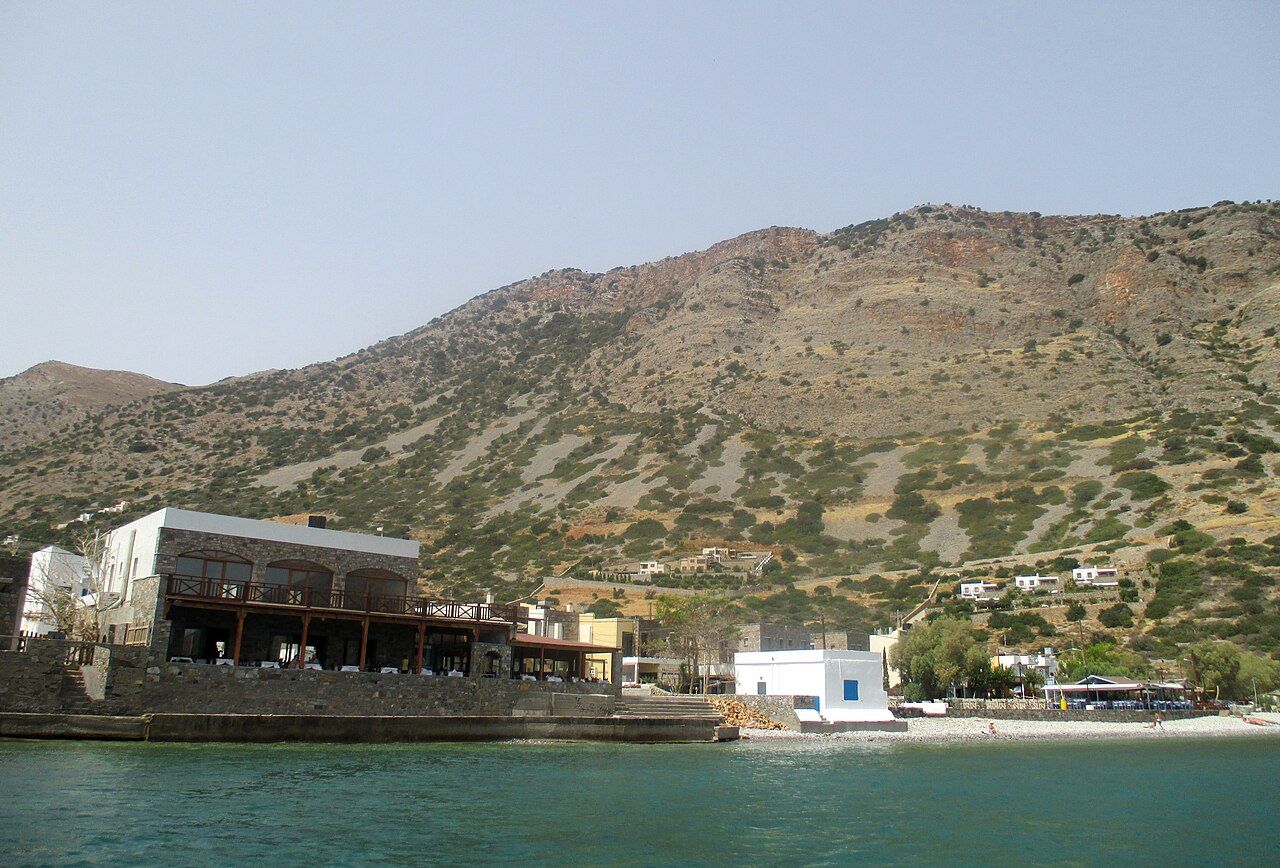
Plaka is the closest point on Crete to Spinalonga. The village sits at the foot of a steep, scrubby mountainside, looking straight across a narrow channel at the walls of the islet. It was once a small fishing settlement and a supply point for the colony on the other side. Today it is a quiet place to swim, to cross to the island and to watch the evening fall over the strait.
A village at the water's edge
The village is little more than a road running along the shore with houses, a few cafes and a small harbour. Behind it the mountain rises steeply, bare rock and green scrub in streaks. That backdrop is part of the appeal. The land gives way to sea quickly here, and nothing much has been built up the slope.
Plaka has grown in recent decades, as has every village on this coast, but it has kept a modest scale. Some of the older stone buildings have been restored, and newer ones mostly follow the same style. It feels like a place where people stop on the way somewhere rather than a destination in its own right, and that is exactly why it is pleasant.
For the history of the islet across the water, including the decades of the leper colony, read our main guide to Spinalonga. Seen from Plaka, it helps to know that during those years this shore was the nearest the patients came to the rest of Crete. Supplies went across from here, and it is often said that relatives came to this shore simply to look across at people they could not visit.
The pebble beach and the clear water
The beach at Plaka is made of smooth, pale pebbles rather than sand, and that is the reason the water is so clear. There is little fine sediment to stir up, and on a calm day you can see the bottom several metres down. The shore shelves fairly quickly, so it suits confident swimmers, and the colour shifts from turquoise near the edge to deep blue further out.
The strait catches more wind than the inner Elounda bay. When the summer north wind blows, waves can roll in and the water feels cooler. On still mornings it is often glassy. Sunbeds and umbrellas are usually set out in summer on part of the beach, while other stretches are left open for anyone with a towel.
- Bring water shoes. Pebbles are hard on bare feet, especially when hot.
- Snorkelling along the rocks at either end shows small fish and the odd octopus.
- There is limited natural shade, so a hat and sun cream matter more than usual.
The short crossing
The main reason most visitors come to Plaka is the boat to Spinalonga. Small boats shuttle across the strait through the day in season, and the trip takes around ten minutes. It is the quickest and usually the cheapest way to reach the islet, although prices and departure times change from year to year and with the weather. Ask at the harbour about return times.
Because the crossing is so short, it is easy to time your visit to suit the heat. Go over on one of the first boats of the morning, spend a couple of hours on the islet, and be back in Plaka for a swim before the hottest part of the day. The other good choice is the late afternoon, when the light on the walls is softer and many of the larger day boats have gone back to Elounda and Agios Nikolaos.
Remember that the boat fare does not include entry to the site on Spinalonga, which is paid separately on arrival. Opening hours vary by season.
Walking from Elounda
The distance from Elounda harbour to Plaka is about five kilometres. The road follows the coast, climbing and dropping above coves and small headlands, and there are stretches where you can drop down to the shore or use older tracks beside the road. It is a fine walk with the islet ahead of you most of the way, but parts of it are on the road edge with traffic, and almost none of it is shaded.
If you want to walk it, do so early in the morning, carry plenty of water and wear proper shoes. Many people walk one way and take a taxi or bus back. Buses on this stretch are not frequent, so keep a taxi number handy. There is more on transport in our guide to getting around east Crete.
Driving is simple, though parking in Plaka can be tight in high season. Arrive early or be ready to park along the road a little way from the centre.
Evenings by the strait
When the last boats have gone, Plaka changes mood. The harbour quietens, the cafes along the front fill with people having a slow dinner, and the walls of Spinalonga catch the last of the light. The mountains of the peninsula opposite turn pink and then grey.
It is a good place to eat simply, with fish and Cretan dishes served at tables near the water. Our guide to the Cretan table gives an idea of what to look for on a menu. Many visitors staying in Elounda come up here for one evening during their stay, just for the change of view.
Before you head back
The road back to Elounda after dark is winding and unlit in places. Drive slowly, watch for people walking on the verge and allow time. If you have eaten well and had a glass of wine, a taxi is the better choice.
Practical notes
A few simple points make a day at Plaka go more smoothly:
- The shoulder months of spring and autumn suit the crossing best, with warm sea from June to October.
- In July and August, swim in the morning and keep the middle of the day for shade.
- Carry cash for the boat, as payment options can vary.
- Check the wind forecast. A strong north wind makes the strait rough and can stop the crossing.
Plaka is not a place of grand sights. It is a pebble shore, a short crossing and a long view, and for most people that is enough.
Lent to this page by
Photographs: Ggia / CC-BY-SA-3.0; Vadim Indeikin / CC-BY-SA-3.0; Mietek Ł / CC-BY-SA-3.0; Tomisti / CC-BY-SA-4.0; Doris Antony, Berlin / CC-BY-SA-3.0


