
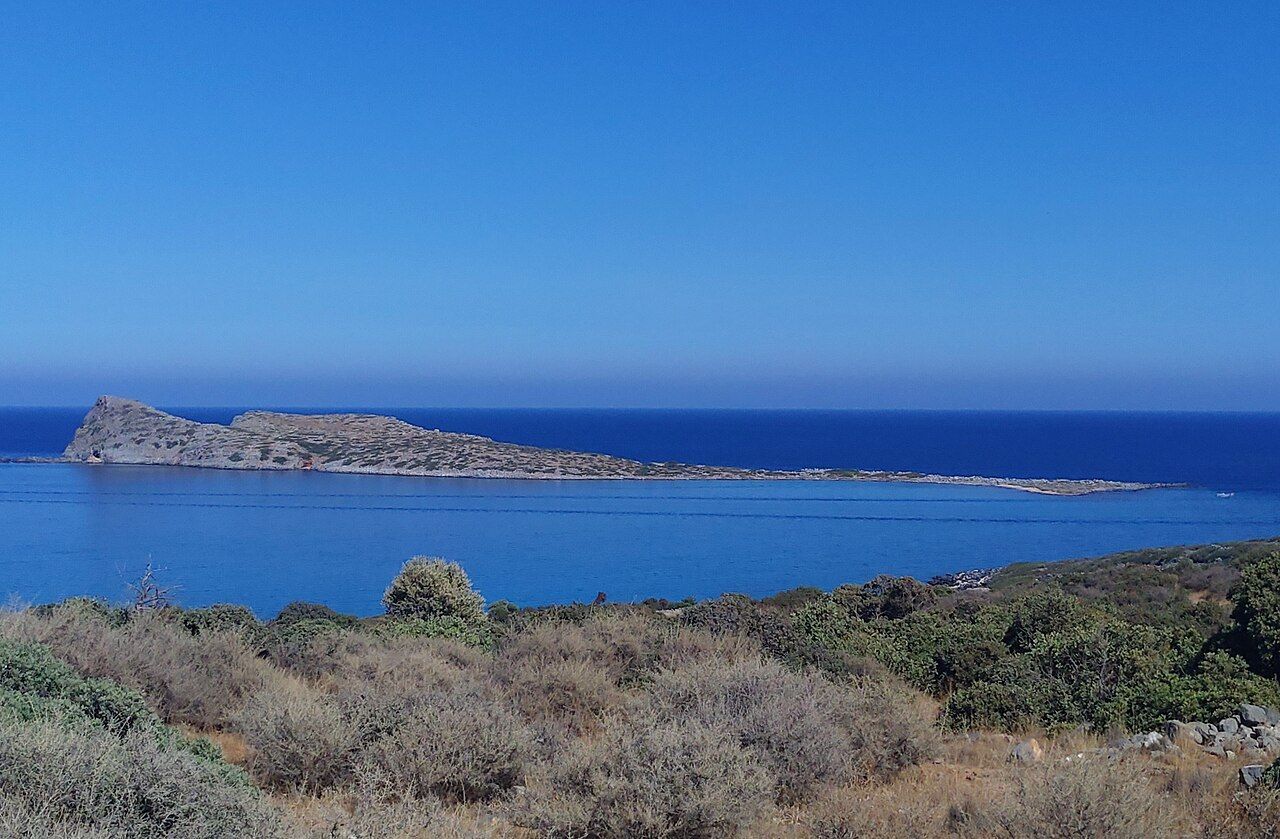
The peninsula that shelters the Elounda bay has several names. Maps often call it the Spinalonga peninsula, older texts call it Kalydon, and locally it is usually Kolokytha. Whatever you call it, it is a long hump of bare rock and scrub, empty of villages, joined to the mainland by a narrow causeway. Crossing it on foot to the bay on the far side makes one of the best short walks near Elounda.
Across the causeway
The walk begins at the southern end of Elounda, where the causeway leaves the shore beside the old salt pans. You follow it out past the ruined windmills and cross the small bridge over the canal. On the far side, the ruins of the drowned city of Olous lie in the shallows just behind you, and the remains of an early Christian basilica with a mosaic floor sit close to the path.
Nearby is the small church of Agia Fotini. It is a simple chapel, and it marks the point where the paved world ends and the peninsula begins. From here a dirt track and then a footpath head off across the land.
Distance and time
From the far end of the causeway to Kolokytha bay is roughly two to three kilometres each way, depending on the route you take. Allow forty minutes to an hour on foot from Elounda harbour, and the same back, plus time for a swim. The path is not difficult, but it is rocky and uneven in places.
The path to the bay
The main route follows a rough track along the southern side of the peninsula before climbing gently over a low saddle. As you rise, the view opens behind you across the Elounda bay towards the mountains, and ahead towards the open sea. The track then drops down towards the bay on the eastern side.
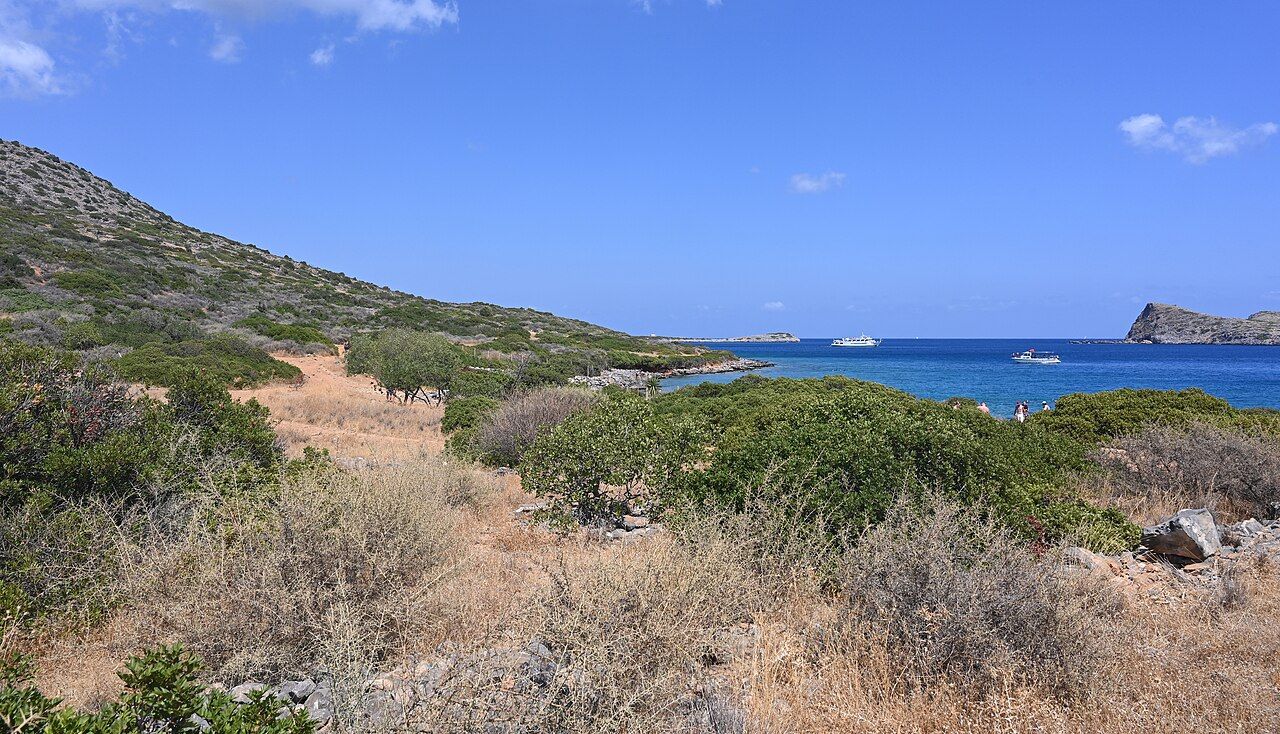

The way is generally clear, but it is worth having a map or offline map on your phone, as small side paths branch off in several places. There are no signs to speak of, and no water or facilities along the route.
Kolokytha bay itself is a sheltered curve of clear water, with a small beach of sand and pebbles and rocky edges. The water is often a pale turquoise near the shore. Offshore lies the small rocky islet of Kolokytha, which gives the area its name. Excursion boats from Elounda and Agios Nikolaos often anchor in the bay around midday for a swim stop, so it can feel busy at that hour even though there is no road.
Wild herbs and the scent of the land
The peninsula is classic Cretan phrygana, the low, aromatic scrub that covers so much of the island's dry hillsides. As you walk, you brush past thyme, sage, savory and other small shrubs that release their scent in the heat. In spring the land is greener, with wild flowers among the rocks, and the smell is stronger still.
By midsummer most of the plants have dried to grey and brown, and the land looks harsh. But the scent remains, especially in the early morning and the evening. Our guide to olive trees and herbs describes the plants you are likely to smell along the way.
There are few trees on the peninsula. A handful of carobs, olives and wild pear grow in sheltered spots, and goats graze the slopes. You may hear their bells before you see them.
Shade, water and footwear
This is the part that matters most. The peninsula has almost no shade, and in summer the heat reflected off the rocks is intense. People do get into difficulty on short walks like this one, simply because they set out too late with too little water.
- Start early. In July and August, be on the path by eight or earlier, and back before midday.
- Carry at least two litres of water each, more on a hot day. There is nowhere to refill.
- Wear a wide hat and cover your shoulders.
- Walking shoes or sturdy trail sandals are much better than flip-flops on the loose stones.
- Tell someone where you are going, and carry a charged phone.
- Avoid the walk entirely in very strong wind or during a heatwave.
Spring and autumn are the ideal seasons. In April and May the land is green and the temperatures are mild. In October the sea is still warm from the summer and the walking is comfortable.
Swimming in Kolokytha bay
The bay is one of the clearest swimming spots near Elounda. The water is sheltered from the prevailing north wind, so it is often calm when other beaches are choppy. Snorkelling along the rocky edges shows fish, sea urchins and patches of sea grass.
There are no sunbeds and no buildings, so bring everything you need, and take everything back with you, including rubbish. The sun is strong on the beach and the only shade is what you carry.
Boats and quiet times
Because excursion boats stop here, the bay is at its quietest early in the morning and in the late afternoon. If you can time your walk to arrive before the boats, you may have the place nearly to yourself.
Going further
Fit walkers sometimes continue along the peninsula towards its northern tip, opposite Spinalonga. The terrain is rougher and there is no real path for much of it, so this is only for experienced hikers with good shoes, plenty of water and time to turn back. Most people are content with the bay.
The return walk retraces the same route. As you come back over the saddle, the whole Elounda bay spreads out ahead of you, with the village on the far shore and the salt pans and windmills below. It is one of the finest views in the area, and it costs nothing but an early start.
Lent to this page by
Photographs: ArtemiyPavlov / CC-BY-SA-3.0; Vadim Indeikin / CC-BY-SA-3.0; Ggia / CC-BY-SA-3.0; Tomisti / CC-BY-SA-4.0; Mietek Ł / CC-BY-SA-3.0


