
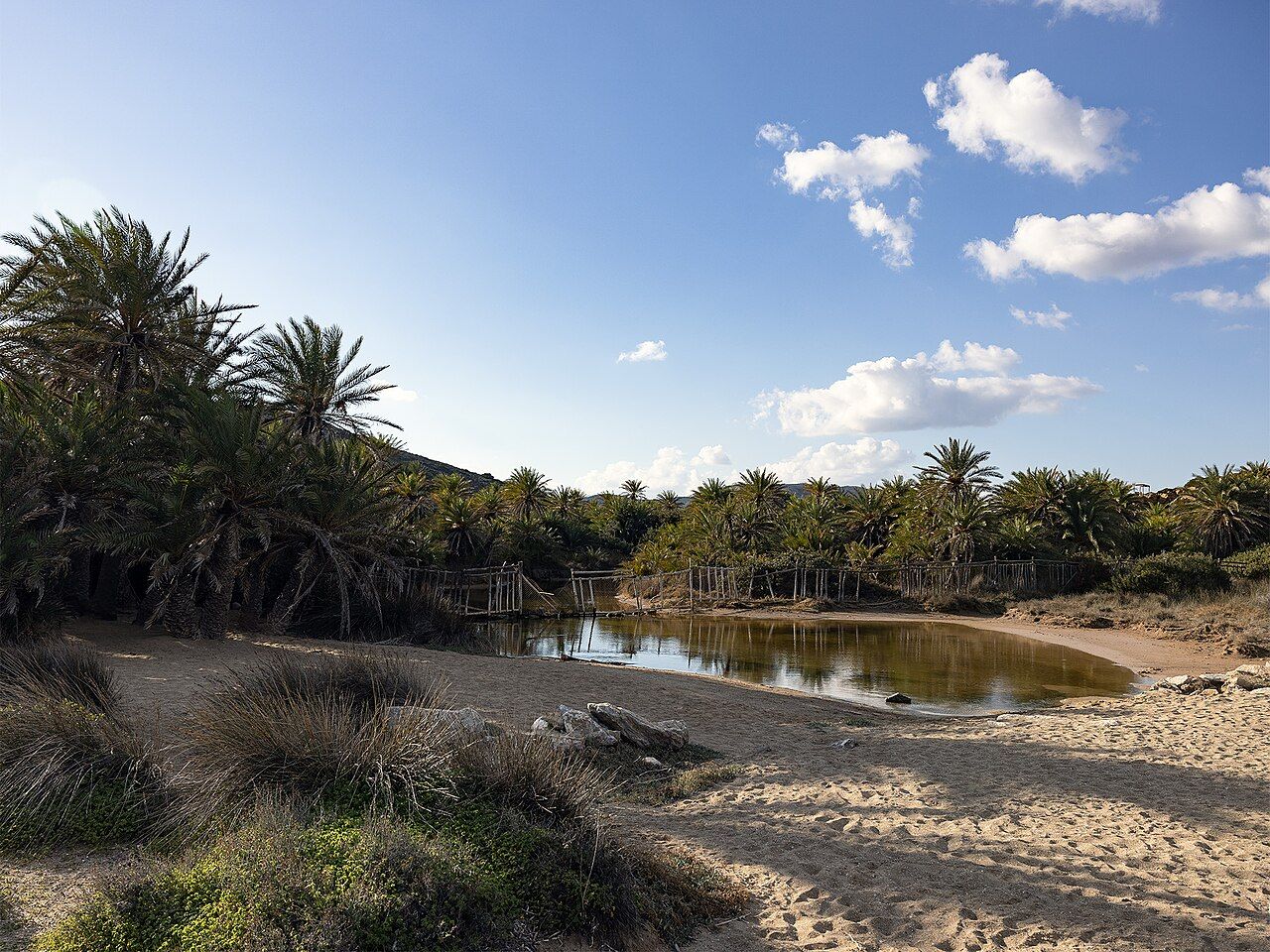
East of the Mirabello Bay, the island grows quieter. The mountains run down to the sea, the villages are smaller and the landscape drier. At the far end lies Sitia, a calm harbour town, and beyond it the fortified monastery of Toplou and the palm grove at Vai. Seeing all three from Elounda makes a long but rewarding day out.
The long drive and where to break it
From Elounda, the road runs south through Agios Nikolaos and then east along the Mirabello Bay, past Istro and Pachia Ammos at the head of the gulf. From there it climbs along the mountainside towards Sitia, with wide views back over the water. Allow roughly an hour and a half to two hours to Sitia without stops, and a little more to Vai.
The road is generally good but winding for long stretches, with steep drops in places. It is tiring to drive in one go, so plan a break or two. Some good places to stop:
- Gournia, the Minoan town near Pachia Ammos, where streets and houses are laid out on a low hill.
- The viewpoints above the bay on the road past Kavousi.
- Mochlos, a small fishing village below the main road, with a little island just offshore.
Our guide to the Mirabello Bay covers the first part of the route in more detail.
Sitia, the quiet town
Sitia is the main town of the far east of Crete. It spreads up a hillside above a wide harbour and a long beach. Compared with Agios Nikolaos it is calmer and less given over to visitors, and it keeps the feel of a working town.
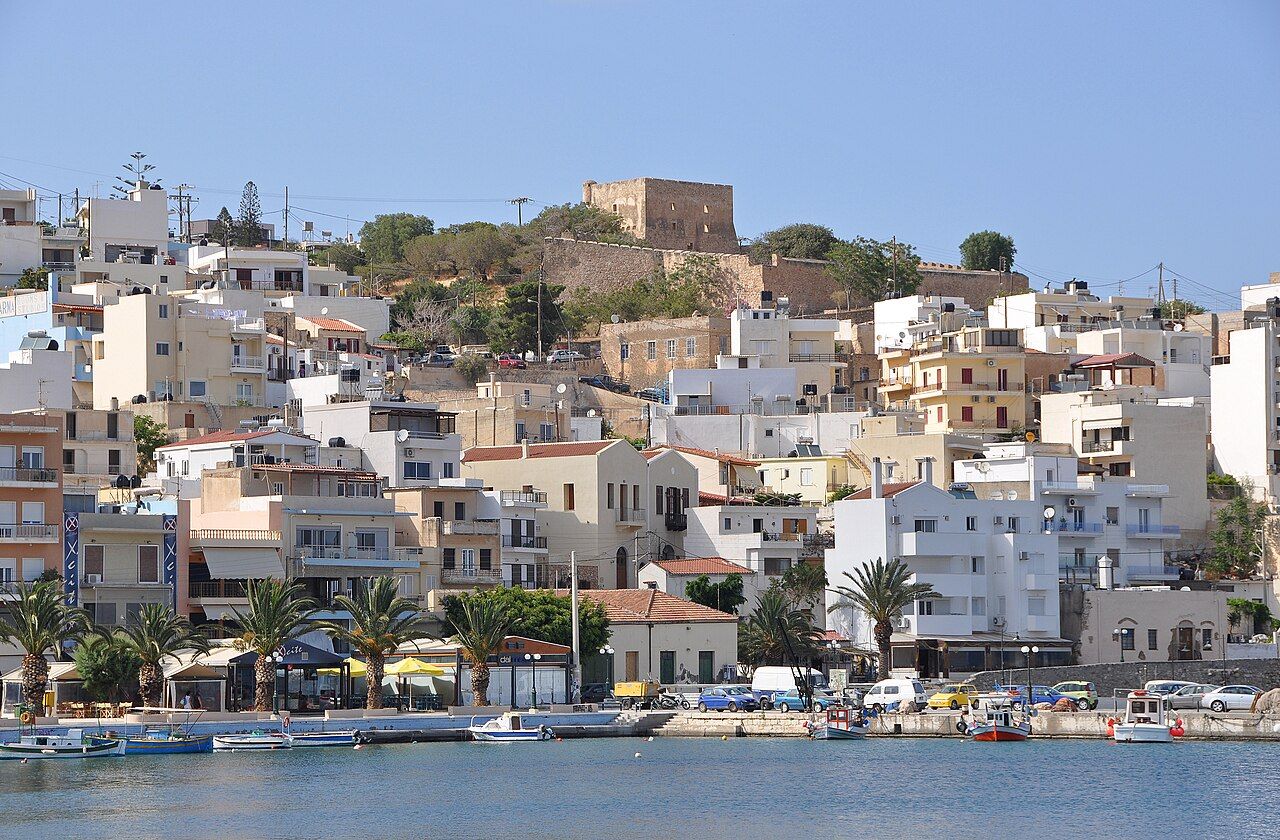

Above the town stand the walls of a Venetian fortress, known locally as Kazarma. You can walk up to it through the steep streets for a view over the harbour. The town also has an archaeological museum with Minoan finds from the eastern end of the island. Hours and prices change.
The waterfront is a good place for a break, with cafes and places to eat along the harbour. The town beach runs east from the centre, long and sandy, with some shade from trees in places.
The fortified monastery of Toplou
North-east of Sitia, on a bare plateau, stands the monastery of Toplou. It is one of the most important monasteries in Crete, and one of the most striking, because it looks more like a fortress than a religious house. High walls, a strong gate and a tall bell tower show how it had to defend itself through centuries of raids and wars.
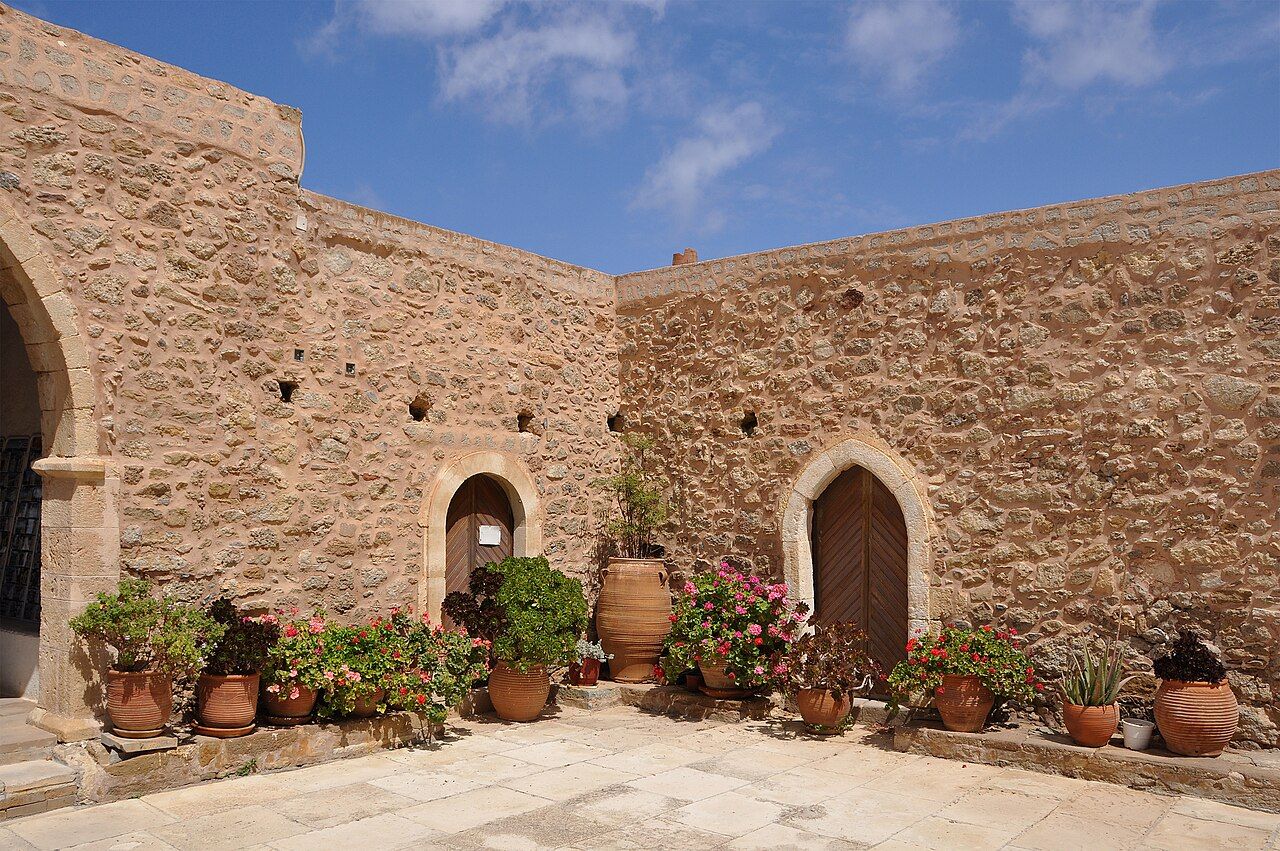

Inside, a quiet courtyard is surrounded by the monks' cells and the church. The church holds notable icons, including a famous eighteenth-century work packed with small scenes. The monastery also has a small museum. Toplou is still a working monastery and is known for its olive oil and wine.
Visitors are welcome at set hours, but those hours change, and there may be an entry charge for the museum. Modest dress is expected: cover your shoulders and knees. Carry a light scarf or wrap if you are in beach clothes.
The palm grove at Vai
Vai lies on the coast a short drive beyond Toplou. It is famous for its grove of Cretan date palms, a native species found only in a few places around the Aegean. The palms grow thickly behind a curving sandy beach, and the effect is unlike anywhere else in Greece.
A story told locally says the palms grew from date stones dropped by soldiers or pirates long ago. Botanists regard the Cretan date palm as native to the island, and the grove as natural. Whatever its origins, it is now protected, and visitors are asked to stay out of the grove itself to spare the trees.
The beach is sandy with clear water, and it gets busy in summer, especially at midday. Sunbeds and umbrellas are usually available in season. The palms give some shade near the back of the beach, but you cannot enter the grove. There may be a parking charge in season.
Quieter alternatives
If Vai is crowded, there are smaller coves nearby. Just north lie the remains of ancient Itanos, an old city on the coast with beaches beside it. Further south, the coast around Kato Zakros is wilder and quieter, though it adds a lot of driving to the day.
Timing the day
This is a full day, and the heat in summer is a real factor. A sensible plan:
- Leave Elounda early, ideally by eight.
- Drive straight to Vai and swim before the crowds arrive.
- Visit Toplou late in the morning.
- Have lunch and a rest in Sitia during the hottest hours.
- Drive back west in the late afternoon, with the low sun lighting the bay ahead of you.
Carry plenty of water in the car, and do not underestimate the driving. Many people find it more comfortable to stay a night in Sitia and spread the trip over two days.
Buses
Buses run from Agios Nikolaos to Sitia, and in summer there are some services on to Vai. Frequency is limited and timetables change with the season. Our guide to getting around east Crete has more on transport.
The far east of Crete rewards those who make the effort. It is quieter and less developed than the north coast, and its palms, its monastery and its harbour town stay with you long after the drive home.
Lent to this page by
Photographs: C messier / CC-BY-SA-4.0; Marc Ryckaert ( MJJR ) / CC-BY-3.0; Mustang Joe / CC0-1.0; Moonik / CC-BY-SA-3.0; Bernard Gagnon / CC-BY-SA-4.0


